

How to Buy a Comic Book Collection Without Overpaying
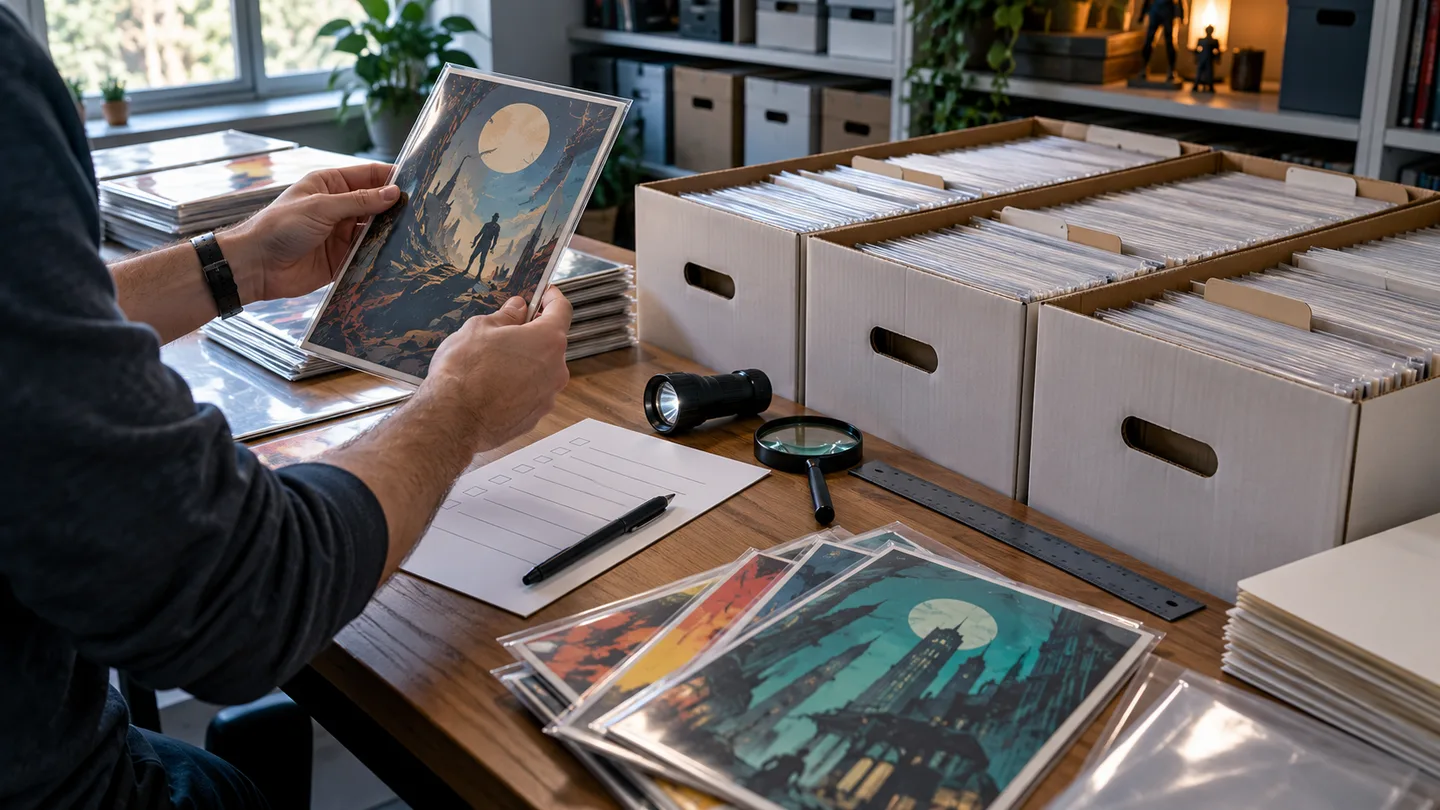
Buy a comic collection by setting a maximum budget first, inspecting the books that could change the decision, and pricing the remainder from a documented sample. A box’s claimed count or a few attractive covers cannot establish what the whole lot is worth.
Start with the buying decision
Write down whether you want keys, a run, reading copies, resale inventory or a personal collection. That goal changes what evidence matters. A buyer seeking one issue should not pay a premium for hundreds of unrelated fillers; a reader may value completeness and condition differently from a reseller.
The only fresh intent signal available for this topic was one GSC impression and zero clicks for “how much should you pay for comic collection” during September 28–October 25, 2026. It suggests a real question, not a reliable volume estimate.
Inspect before making an offer
Ask to see the actual boxes, not only a top layer or a spreadsheet. Verify the count by box or short run, photograph labels, and record duplicates and missing issues. Pull a sample from the top, middle and bottom of each box. A convenient top-of-box sample can overstate quality; this is a practical bias check, not a statistical guarantee. If you buy through eBay, read the current Money Back Guarantee policy: coverage generally turns on non-delivery or an item that does not match the listing, and exclusions and deadlines apply. It is a dispute process, not a substitute for inspecting a collection before paying.
For books that could change the offer, inspect:
| Check | What to record | Why it changes the offer |
|---|---|---|
| Identity | Series, issue, date, printing, variant | Lookalike reprints or facsimiles are different products |
| Completeness | Missing pages, coupons, centerfold, inserts | Missing material can change usability and comparability |
| Condition | Spine, corners, tears, writing, odor, water exposure | A cover alone cannot establish a grade |
| Certification | Company, grade, label and seal | Certified and raw copies require separate comparisons |
| Storage | Bags, boards, boxes, moisture or pests | Handling and replacement costs affect the budget |
Use our first-printing checklist and grading-scale explanation for research vocabulary. Do not press, clean or repair books during the inspection.
Build a buying budget, not a headline total
Separate the offer into: likely resale or personal-use value, transport, bags and boards, cleaning or professional handling you actually plan to pay for, platform fees, postage, taxes where applicable, and your time. For a resale plan, use net proceeds rather than adding up optimistic asking prices.
Fictional budget example
Suppose a fictional lot has 60 individually checked books and 440 mixed books. A buyer’s documented scenarios are $420–$600 for the checked group and $120–$220 for comparable mixed lots. They reserve $90 for transport and supplies and set a $300 time/risk buffer. Their maximum offer is not automatically the $1,040 high total; they choose a lower ceiling after deciding how quickly they can sell and how much uncertainty they can absorb. These numbers are invented, not a market rule.
Recognize sample and seller-description bias
Treat “mostly high grade,” “all key issues,” “complete collection,” and “untouched since the 1970s” as claims to verify. Photograph outliers and keep an unresolved list. If the seller will not permit a representative inspection, either reduce the offer for uncertainty or walk away. Do not let one exciting cover determine the price of every box.
For a price record, our sold-price guide explains how to match edition and condition. If you use eBay Product Research, its official documentation says the tool can show three years of sales and accepted Best Offer amounts, but highly specific search terms determine what enters the results (eBay documentation). Our collection valuation guide addresses the seller’s whole-collection scenarios; this article stays focused on the buyer’s inspection and offer discipline.
Make the offer explainable
Give the seller a scope: boxes included, counted quantities, inspected sample, visible exclusions, pickup or shipping responsibility, and whether inspection can change the offer. Keep the offer conditional until you have checked the books you were promised. A written rationale helps both sides when the number is lower than a guide total.
For auction purchases, read the venue’s actual terms before comparing a hammer price with your budget. Heritage states that terms vary by sale and notes a standard buyer’s premium on many auction transactions (Heritage buyer guidance); treat any premium, shipping, taxes and return rights as sale-specific rather than applying a universal percentage. ComicValue on iOS and Android can help create an identification queue. Store descriptions are current product information, not proof of condition, rarity or resale value.
This guide is educational and does not promise profit or a universal collection discount. The hero is an original AI-generated conceptual illustration; it does not depict a real collection, seller, inspection or transaction evidence.
Frequently Asked Questions
How much should I pay for a comic collection?
There is no universal percentage or per-book price. Identify the books that could change the decision, sample the remainder, estimate realistic net proceeds, and set a maximum offer below that scenario after costs and effort.
Should I buy a collection without inspecting it?
Only if the price reflects the uncertainty and you can absorb the downside. An unverified box count or seller description is not a substitute for inspection.
Explore Key Comic Price Guides
Action Comics #1 (1938)
Explore the issue and valuation context
Detective Comics #27 (1939)
Explore the issue and valuation context
Amazing Spider-Man #300 (1988)
Explore the issue and valuation context
Incredible Hulk #181 (1974)
Explore the issue and valuation context
Browse our master price guide directory for 250+ key issues.