

Comic Book Grading Scale: 0.5–10.0 Chart and Condition Checks
The CGC comic book grading scale runs from 0.5 (Poor) to 10.0 (Gem Mint). It describes condition, not a guaranteed market value. Very Good (VG) is 4.0, Fine/Very Fine (FN/VF) is 7.0, and Near Mint/Mint (NM/M) is 9.8. Use collecting terms alongside the number and an honest defect description.
This reference helps you read listings and plan a condition review—not certify your own copy from a photograph. For an existing certified book, its company, label category, page quality and disclosed qualifications matter alongside the numerical grade.
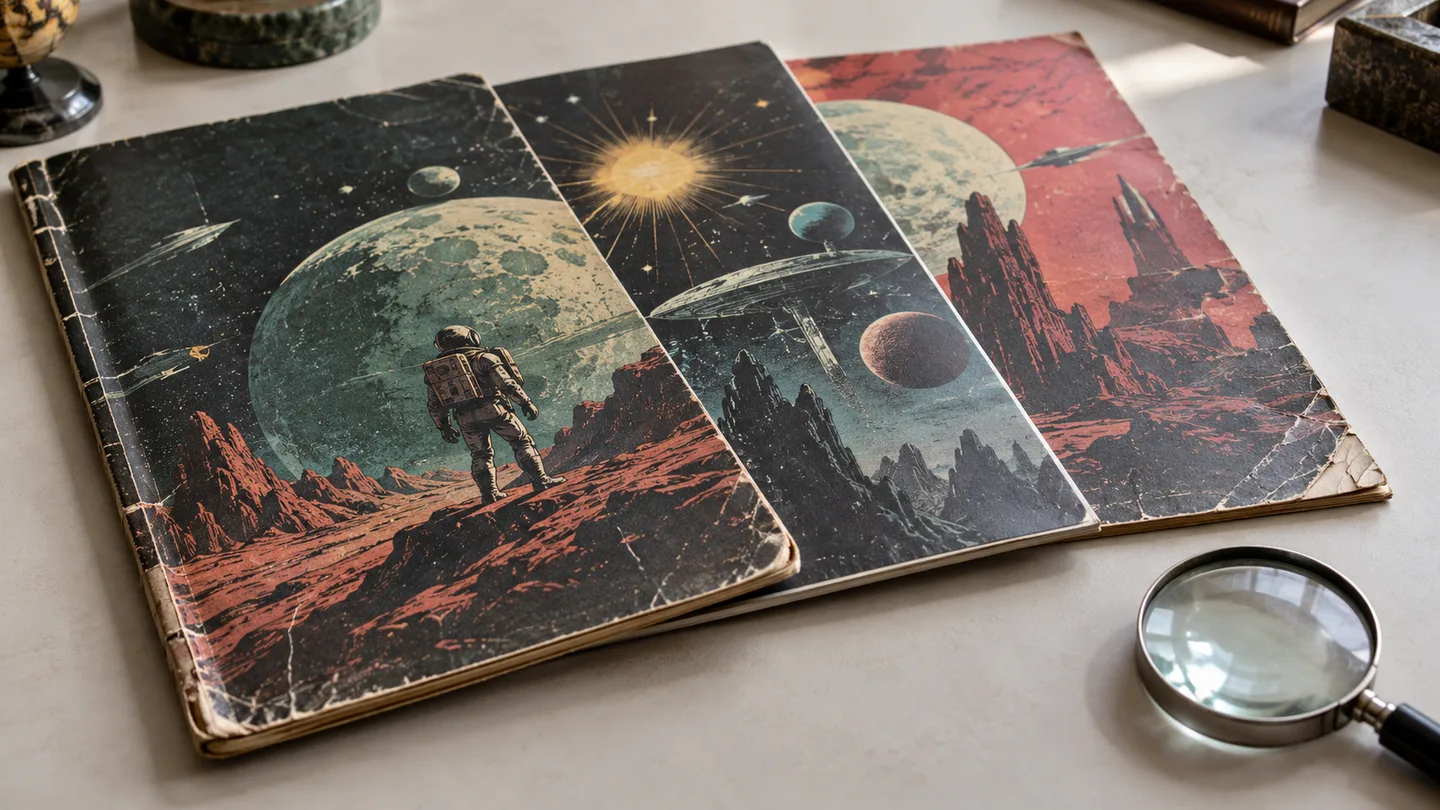
Primary references checked October 11, 2026. The hero is original AI-generated editorial artwork illustrating wear; none of the pictured books has been professionally graded. Condition scenarios and budget figures below are illustrative, not testing or recorded market sales.
Comic grading chart: the published CGC numbers and terms
This chart maps CGC’s official standard grading scale. It is a reference to CGC’s terminology, not a claim that every seller or certification service applies identical standards.
| Grade | Term | Abbreviation |
|---|---|---|
| 10.0 | Gem Mint | GM |
| 9.9 | Mint | M |
| 9.8 | Near Mint/Mint | NM/M |
| 9.6 | Near Mint+ | NM+ |
| 9.4 | Near Mint | NM |
| 9.2 | Near Mint− | NM− |
| 9.0 | Very Fine/Near Mint | VF/NM |
| 8.5 | Very Fine+ | VF+ |
| 8.0 | Very Fine | VF |
| 7.5 | Very Fine− | VF− |
| 7.0 | Fine/Very Fine | FN/VF |
| 6.5 | Fine+ | FN+ |
| 6.0 | Fine | FN |
| 5.5 | Fine− | FN− |
| 5.0 | Very Good/Fine | VG/FN |
| 4.5 | Very Good+ | VG+ |
| 4.0 | Very Good | VG |
| 3.5 | Very Good− | VG− |
| 3.0 | Good/Very Good | G/VG |
| 2.5 | Good+ | G+ |
| 2.0 | Good | G |
| 1.8 | Good− | G− |
| 1.5 | Fair/Good | Fa/G |
| 1.0 | Fair | Fa |
| 0.5 | Poor | PR |
Notice 1.8, 9.2 and 9.9: these are not uniform half-point steps. Do not interpolate a score that the chosen service does not list.
What do FN/VF and “Very Good” actually tell you?
FN/VF means Fine/Very Fine, or 7.0 in the chart above. A seller may write “F/VF”; ask which convention they mean. An abbreviation in a raw listing is the seller’s assessment, not independent certification.
VG means Very Good, or 4.0. It does not mean nearly new. Read the seller’s notes and examine pictures of both covers and the interior where available. A correct abbreviation with inadequate photos still leaves important questions unanswered.
Why 9.8 is not “perfect,” and 9.6 is not a fixed discount
CGC’s scale allows negligible defects at 9.8; 9.9 and 10.0 sit above it. A small visible imperfection does not, by itself, establish a new numerical grade. Its character and the rest of the book need to be considered together.
Do not use a rule such as “three spine ticks means 9.2” or “a new comic must be 9.6.” This article does not provide a defect-to-points formula because that would imply precision we have not established. Handling, manufacturing and storage questions cannot be answered simply by knowing a comic’s age or whether it was read.
There is no universal 9.8-to-9.6 price multiplier. Compare recent sales of the same issue, edition and label category at each grade. Keep samples separate, record dates, and check whether there are too few transactions to support a useful comparison. Our sold-price research guide explains how to avoid mixing asking prices and completed transactions.
A practical condition inspection: describe before you score
Prepare a clean, uncluttered surface and good lighting. Avoid food, liquids or attempts to flatten a book by force. If paper is fragile or opening seems unsafe, stop and obtain experienced help. Protecting the copy matters more than completing a checklist immediately.
| Area | What to document | What a cover photo cannot settle |
|---|---|---|
| Front and back covers | Creases, tears, stains, missing material, surface wear | Wear hidden on the back or obscured by glare |
| Spine and corners | Stress lines, splits, roll, blunting, attachment issues | Full structural condition from a single angle |
| Staples and nearby paper | Visible rust, staining, looseness or tears | Interior effects without a safe examination |
| Interior and contents | Loose or missing pages, cut-outs, inserts, stains | Completeness from the front cover alone |
| Prior work and signatures | Disclosed repairs, marks, signatures, authentication status | Whether an unexplained alteration is authentic or professionally assessed |
Take overall front/back photos plus close-ups of relevant flaws. Write the location and extent in plain language. “Lower spine split; interior not checked” communicates more than “looks mint.” Do not erase, recolor, tape or otherwise alter a book to improve a research photo.
Three useful scenarios—not grade assignments
A glossy cover with several small spine marks: photograph the marks under light that reveals them, then inspect the back and interior if safe. Do not declare 9.6 or 9.8 from the front alone. Compare raw listings with similarly disclosed wear, not the highest numerical label in the results.
An attractive comic with a cut-out coupon: disclose the missing material even if the story appears readable. CGC’s label guide explains qualified labels for significant defects. A qualified number should not be silently compared with an otherwise unqualified copy at that number.
A handwritten name or signature: record the mark and supporting provenance. Do not apply a blanket “writing caps every comic at 4.0” rule. CGC distinguishes witnessed Signature Series signatures from JSA-authenticated unwitnessed signatures. Authentication, label treatment and condition are different questions; a signed copy is not automatically more valuable.
Read the whole label, not only the grade
For a certified comic, compare these details with the listing and physical holder:
- Series, issue, date and edition.
- Numerical grade and certification company.
- Page quality and full label category.
- Notes about restoration, conservation, signatures or qualifying defects.
- Certification number and any available record or images from the service.
CGC’s label descriptions distinguish Universal, Qualified, Restored and Conserved labels, as well as signature categories. Its scale also has separate page-quality terminology. Matching a numerical grade does not erase those differences.
CGC grader notes can explain recorded condition issues when available. CGC says notes are discretionary and may not list every defect. Missing notes do not prove a book is flawless. Use the company’s verification tool; a record match is a research step, not a guarantee that a seller’s photos or holder are genuine.
Should you pay for professional grading?
First decide what you need: independent condition assessment, encapsulation, a selling format, or documentation. Then compare full costs with plausible outcomes rather than assuming the highest grade.
For a fictional budget, suppose estimated raw selling proceeds are $60, grading and related costs total $50, and estimated certified selling proceeds before those grading costs are $90 at one plausible grade or $140 at another. Subtracting the $50 produces outcomes of $40 and $90. Only the second beats the $60 raw alternative. These are teaching assumptions, not current prices, odds or a recommendation to submit.
Use the CGC cost guide and worksheet for dated fee research, and the submission checklist for preparation questions. Include shipping, packing, optional services, selling charges and the risk that your expected grade is not assigned. Grading can serve a collecting purpose even when it does not improve net proceeds; say which purpose you are evaluating.
Keep a condition record with your collection
Save the issue identity, inspection date, observed defects, photos, unchecked areas, certification details if present, and sales used for comparison. If uncertain, record “unassessed raw copy” rather than manufacturing a professional-looking score.
For an end-to-end workflow, continue with how to find comic book value. ComicValue can be a mobile starting point for identification, collection organization and research; review its iOS and Android listings for current features, availability and purchase terms. A cover scan is not a certified condition examination, and neither an app nor a grade guarantees a selling price.
Frequently Asked Questions
What is the comic book grading scale?
CGC's standard numerical scale runs from 0.5 (Poor) to 10.0 (Gem Mint). Its listed grades do not all progress in half-point increments; high grades include 9.2, 9.4, 9.6, 9.8 and 9.9.
What does FN/VF mean in comic books?
FN/VF means Fine/Very Fine and corresponds to 7.0 on CGC's published scale. A seller may write F/VF informally; confirm the grading convention and inspect the actual copy.
What does Very Good mean in comic grading?
Very Good, abbreviated VG, corresponds to 4.0 on CGC's scale. The everyday phrase sounds more pristine than this collecting term, so use the numerical grade and defect description together.
Is CGC 9.8 a perfect comic?
No. CGC calls 9.8 Near Mint/Mint and permits negligible handling or manufacturing defects. Mint 9.9 and Gem Mint 10.0 are higher grades.
Can a cover-scanning app certify a comic grade?
No. Cover identification is not a complete condition examination. Interior completeness, back-cover defects, restoration and other factors may need physical inspection.
Explore Key Comic Price Guides
Action Comics #1 (1938)
Explore the issue and valuation context
Detective Comics #27 (1939)
Explore the issue and valuation context
Amazing Spider-Man #300 (1988)
Explore the issue and valuation context
Incredible Hulk #181 (1974)
Explore the issue and valuation context
Browse our master price guide directory for 250+ key issues.