

How to Store Comic Books: Bags, Boards & Boxes
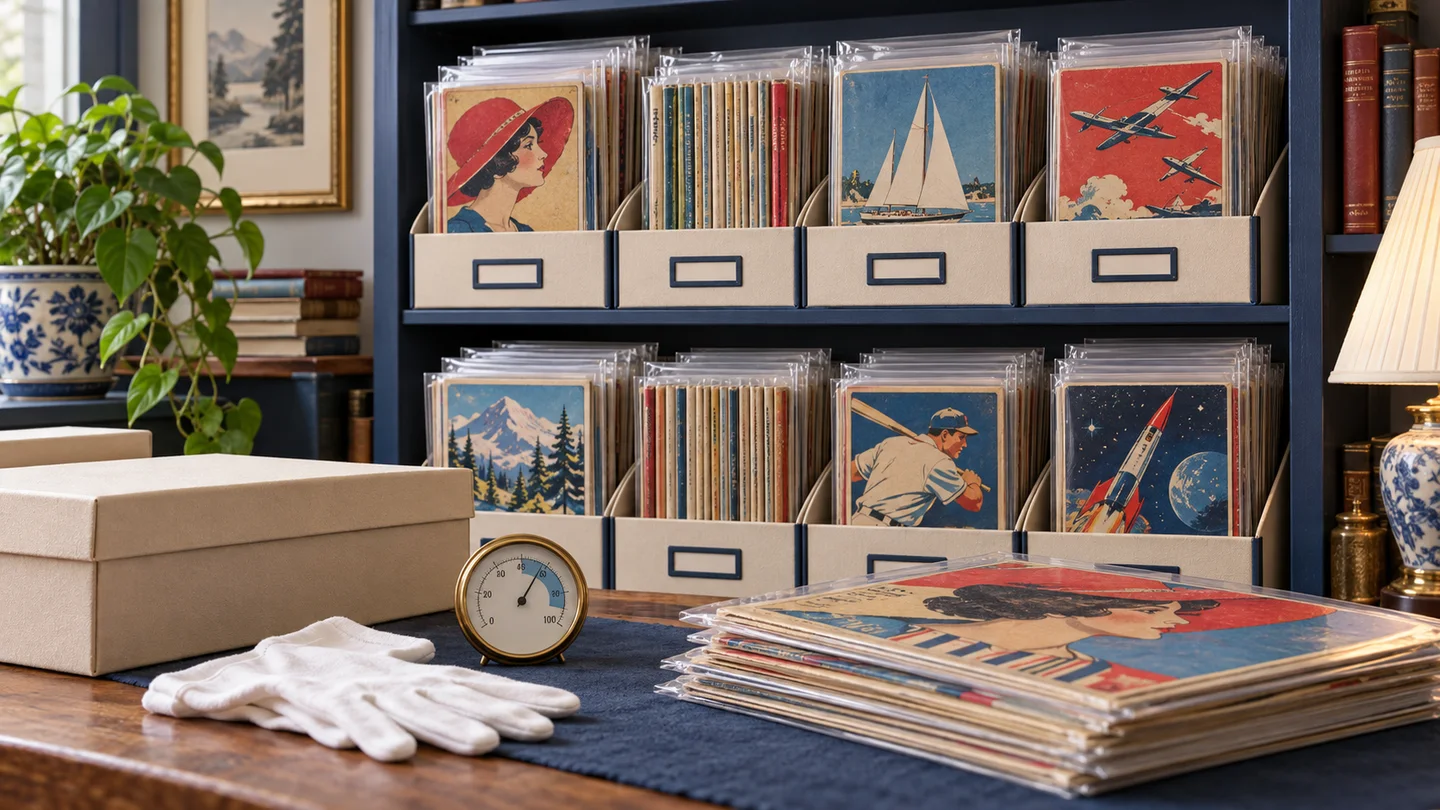
The safest comic-storage setup is simple: one correctly fitted sleeve, one supportive board, a snug but not crowded box, and a cool, stable room. Good storage slows paper aging and prevents avoidable bends, abrasion, dust and moisture exposure. It cannot reverse foxing, fading, tears or prior water damage, and it does not guarantee a future price.
This guide covers raw comics and everyday home storage. It is about preventive care, not pressing, cleaning, restoration or a grading prediction. For an appraisal workflow, see how to find a comic book’s value; for condition terminology, use our comic grading scale guide.
Choose the sleeve and board as a pair
The sleeve keeps handling, dust and casual abrasion off the cover. The board provides support so a thin issue is less likely to curl or slump. Buy by the comic’s actual dimensions and thickness, not only by an age label such as “silver age.” An oversized annual, newsprint book, magazine-format issue or thick special may need a different size.
Look for a sleeve made from a stated stable plastic such as polypropylene or polyester/PET. The Canadian Conservation Institute lists polypropylene and PET among suitable enclosure plastics for paper objects, while also recommending chemically stable materials. Avoid PVC and unlabelled soft plastic for long-term contact. A board should be acid-free or otherwise described by the supplier as archival-quality; if a product does not explain its material, use it for temporary handling rather than making a lifetime claim.
Do not force a comic into a tight bag. The opening should close without pinching the spine, and the board should not be so wide that it rubs the cover when the book is inserted. Fold-over flaps can keep dust out, but adhesive should never touch the comic. Replace a sleeve when it becomes cloudy, brittle, torn or dirty; replace a board if it bends, stains or transfers residue.
| Storage choice | Best use | What to check | Common mistake |
|---|---|---|---|
| Polypropylene sleeve + acid-free board | Most raw single issues | Stated plastic and correct fit | Reusing a yellowed or torn bag |
| Polyester/PET sleeve + acid-free board | Higher-value or frequently handled books | Clear fit and no pressure on corners | Assuming a rigid sleeve removes the need for a board |
| Short box or archival box | A manageable batch kept upright | Strong walls, lid, no overcrowding | Packing books so tightly they bow |
| Toploader or rigid holder | Display or extra impact protection | Smooth interior, room for the bagged book | Treating it as a humidity-controlled case |
| Slab or professional encapsulation | A professionally graded book | Inspect the seal and store as a unit | Stacking heavy objects on it |
“Archival” is not a magic performance grade. A well-made enclosure can buffer dust and short-term changes, but the room still controls the long-term temperature and humidity. CCI recommends tailored enclosures and additional boxes or cabinets for paper objects; it also warns against acidic mats, boxes, tapes, rubber bands and metal fasteners.
Pick a box and orientation that do not stress the book
For a typical raw collection, use a clean, sturdy comic box with a lid and dividers that keep issues supported. Store issues upright, with the spines aligned and enough room to remove one without dragging its neighbours. Keep the box on a shelf or riser rather than directly on a basement floor. Leave clearance from exterior walls, plumbing, radiators, vents and windows.
Keep books with active mould, wetness or an unknown spill physically separate from clean books and boxes. A musty smell warrants inspection, although it does not by itself prove active mould. Do not seal a damp book into plastic. Isolate it from the rest of the collection and seek advice from a conservator or a library preservation service; mold and water can spread damage even when a cover looks intact.
Rare, oversized or fragile comics deserve an individual enclosure designed for their shape. A rigid holder can protect a corner during transport, but it is not a substitute for environmental control. Never attach tape, rubber bands, paper clips or adhesive labels to the comic. Keep any sleeve-closure adhesive away from the book and avoid fasteners that create pressure.
Make the room boring and stable
The Library of Congress recommends a cool environment at or below 70°F (about 21°C) and 30–55% relative humidity for most books, while warning against extremes and frequent swings. NEDCC’s environmental guidance gives 30–60% RH for regularly accessed collection storage. These are preservation references, not a promise that a home can hold one exact number. A small hygrometer can reveal whether your room is routinely damp or fluctuating.
Keep the collection out of direct sun and intense display lighting. CCI explains that light can fade colours and discolour or embrittle paper, and recommends reducing exposure and filtering ultraviolet light where possible. Avoid attics, garages and basements unless you can demonstrate stable conditions; living spaces are usually easier to monitor. Never place a box below a pipe, under an air-conditioning leak, beside a radiator or against a damp wall.
Handle comics as paper objects
Wash and dry your hands before a short inspection, or use clean gloves when the book’s surface is especially vulnerable. CCI recommends minimal handling, clean hands or cotton gloves, and using both hands to move paper objects. Work on a clean, clear table with no food, drink, pens or markers nearby. Support the comic from underneath; do not pull it by a corner or bend the spine flat.
When you need a record, photograph the cover and note the issue, printing clues and visible defects before returning it to storage. Keep your inventory separate from the book itself. Our collection value guide explains how to record condition and evidence without writing on a comic.
A five-minute storage routine
- Inspect the space. Check for water, condensation, pests, dust, direct sun and heat. Read the hygrometer and record unusual changes.
- Inspect the book. Look for dampness, mould, loose pages, sharp bends and residue. Isolate anything suspect before it touches the collection.
- Fit the enclosure. Slide the comic into a correctly sized sleeve with a clean, supportive board. Stop if the corners catch or the spine is pinched.
- Load the box. Stand issues upright with gentle support. Do not overfill, stack heavy items on top or mix awkward sizes where they can slide.
- Review periodically. Once or twice a year, check the room, box, sleeves and boards. Replace damaged materials and update your inventory while each book is already out.
Storage protects condition; it does not establish market value. When you are ready to research a book, confirm its series, issue, printing and condition, then compare appropriate evidence. ComicValue for iOS and Android can be a starting point for organizing cover-based research. The store listings describe the app’s current capabilities; a scan is an identification aid, not a professional grade or appraisal.
Sources and limits
- Library of Congress: Storing Your Books — temperature, RH, light and storage basics; guidance is for books broadly, not comic-specific materials.
- NEDCC: Storage and Handling for Books and Artifacts on Paper — enclosure and handling principles; institutional context may exceed a home collector’s setup.
- Canadian Conservation Institute: Caring for paper objects — stable enclosures, chemically stable materials, handling and light; recommendations are for paper collections generally.
Disclosure: The hero is an original AI-generated editorial illustration, not a photograph or app screenshot. ComicValue publishes this guide and has an interest in its own app; the preservation recommendations above come from the linked public conservation sources.
Frequently Asked Questions
What is the best way to store comic books?
Put each comic in a correctly sized inert plastic sleeve with a suitable support board, then keep the books upright in a sturdy box in a cool, clean, stable living space away from sunlight, leaks and heat sources.
Are polypropylene bags safe for comic books?
Polypropylene and polyester (PET) are commonly used for protective paper enclosures. Choose a product that identifies its material and fit; avoid unknown plastic, PVC and acidic paper products for long-term contact.
Should comics be stored flat or upright?
For ordinary bagged-and-boarded issues, upright storage with gentle support is practical. Do not pack a box so tightly that books bow or become difficult to remove; unusual, oversized or fragile material may need a tailored flat enclosure.
What humidity is safe for comic books?
Use a stable, relatively dry environment. The Library of Congress gives 30–55% relative humidity for most books and warns about fluctuations; NEDCC lists 30–60% for paper and books in collection spaces. Avoid basements, attics and persistent high humidity.
Explore Key Comic Price Guides
Action Comics #1 (1938)
Explore the issue and valuation context
Detective Comics #27 (1939)
Explore the issue and valuation context
Amazing Spider-Man #300 (1988)
Explore the issue and valuation context
Incredible Hulk #181 (1974)
Explore the issue and valuation context
Browse our master price guide directory for 250+ key issues.