

Comic Book Variant Covers: A Practical Value Guide
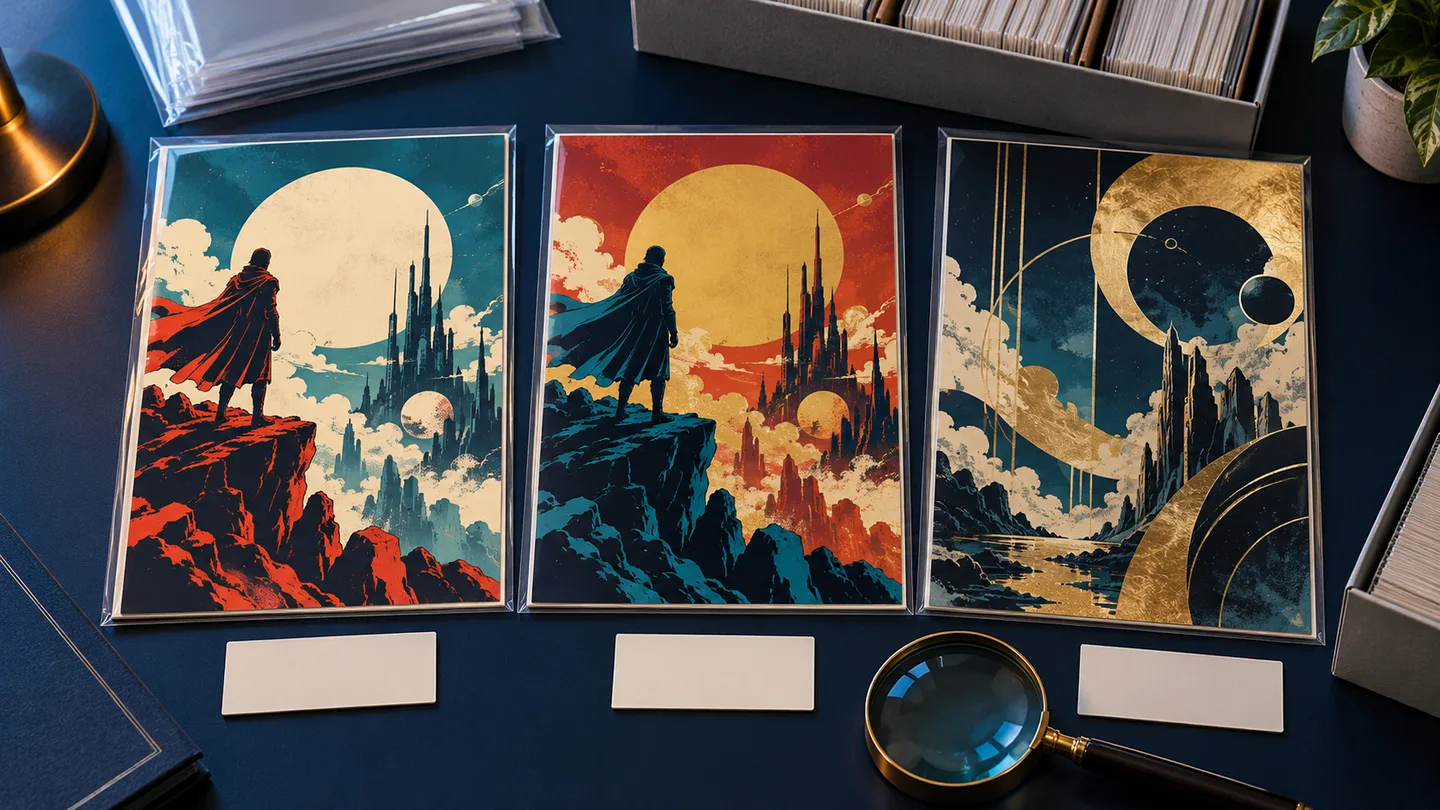
A variant cover is a different cover edition, not a guaranteed premium. “1:25” or “1:100” usually describes a retailer-ordering threshold, while “virgin,” “foil” and “exclusive” describe format or channel. None of those labels, by themselves, proves the total print run, surviving population or future value.
This guide keeps publisher terminology separate from collector shorthand and gives you a repeatable way to research a copy. The hero is AI-generated conceptual artwork using fictional covers; it is not an authentic issue, solicitation image or sales record.
Variant terms in plain language
| Term | Usually describes | What to verify |
|---|---|---|
| Open-to-order variant | A cover a retailer can order without a stated ratio | Publisher solicitation and edition/format |
| Ratio or incentive variant | Eligibility tied to qualifying orders, such as 1:25 | Exact ratio rules and qualifying issue |
| Virgin cover | Art without the usual trade dress | Publisher’s cover designation and printing |
| Foil/cardstock/texture variant | A material or finish change | Format, cover price and certification record |
| Store/convention exclusive | Distribution limited to a named channel | Who commissioned or distributed it |
The words can overlap. A foil cover can also be 1:50; an open-to-order cover can be a store exclusive in a different market. Use the publisher’s description for the exact issue instead of combining labels into a scarcity claim.
What a ratio does—and does not—tell you
DC’s official solicitations provide clear examples. Its Superman: Son of Kal-El #13 announcement lists a main cover, an open variant and a 1:25 variant, with separate prices. DC’s Action Comics #1050 solicitation lists several ratios up to 1:1050 alongside multiple other variants.
Those documents establish how the publisher presented the covers and ratios. They do not disclose a complete print run, retailer-by-retailer ordering, unsold returns, destruction or surviving copies. A 1:100 eligibility rule is therefore not a census. It may correlate with lower availability in some cases, but the correlation must be tested against actual supply and demand.
Do not infer that a 1:25 cover had exactly one copy per 25 printed books. A shop may order unevenly, qualify through a particular program, or sell copies through channels that are not visible in a listing search.
Verify the copy before checking price
Record the series, issue number, cover artist/designation, publisher, cover date, format, price, printing and any exclusive or ratio language. Compare the cover to the publisher’s solicitation or issue record. For graded copies, verify the certification record and label category; for raw copies, describe observable condition without promising a grade.
Keep first printings, later printings, facsimiles, retailer exclusives and convention editions in separate groups. The printing guide explains why a different cover does not automatically mean a later printing. A scanner can suggest an identity, but it cannot establish that the physical copy is the advertised variant.
Compare value with matched completed sales
Search completed transactions for the exact cover and printing. Match grade, page quality, label category, venue, currency and sale date. Exclude active asking prices and listings that use “ratio” without showing the cover designation. If only one sale is available, report that limitation.
Fictional example, for arithmetic only:
| Cover group | Fictional completed totals | Fictional median |
|---|---|---|
| Main cover | $12, $15, $18 | $15 |
| 1:25 variant | $20, $24, $28 | $24 |
The invented median ratio is 1.6× ($24 ÷ $15). It does not prove that every 1:25 variant deserves 1.6×, and it says nothing about print run or future returns. If demand fades or supply increases, later sales can differ sharply.
Use the sold-price research guide to document dates, currency and sample limits. For broader factors such as condition and character demand, see what makes a comic book increase in value. ComicValue’s iOS app and Android app can organize a research lead; verify the edition and sales independently.
Sources checked October 28, 2026. No universal variant premium, print-run count, survival census or investment return is claimed. The hero is AI-generated conceptual artwork, not an authentic cover or pricing evidence.
Frequently Asked Questions
What does a 1:25 comic variant mean?
It generally describes a retailer-ordering eligibility condition: a shop may qualify for one variant by ordering 25 copies of the qualifying issue. It does not state the publisher’s total print run or the number of surviving copies.
Are virgin or foil variants automatically worth more?
No. Format and finish can affect demand, but value still depends on the exact issue, cover, condition, supply and completed sales.
What should I verify before pricing a variant?
Verify the publisher’s solicitation, issue and cover designation, printing, format, grade, label category and completed-sale comparables.
Explore Key Comic Price Guides
Action Comics #1 (1938)
Explore the issue and valuation context
Detective Comics #27 (1939)
Explore the issue and valuation context
Amazing Spider-Man #300 (1988)
Explore the issue and valuation context
Incredible Hulk #181 (1974)
Explore the issue and valuation context
Browse our master price guide directory for 250+ key issues.