

Bronze Age Comic Book Values: Keys, Grades & Editions
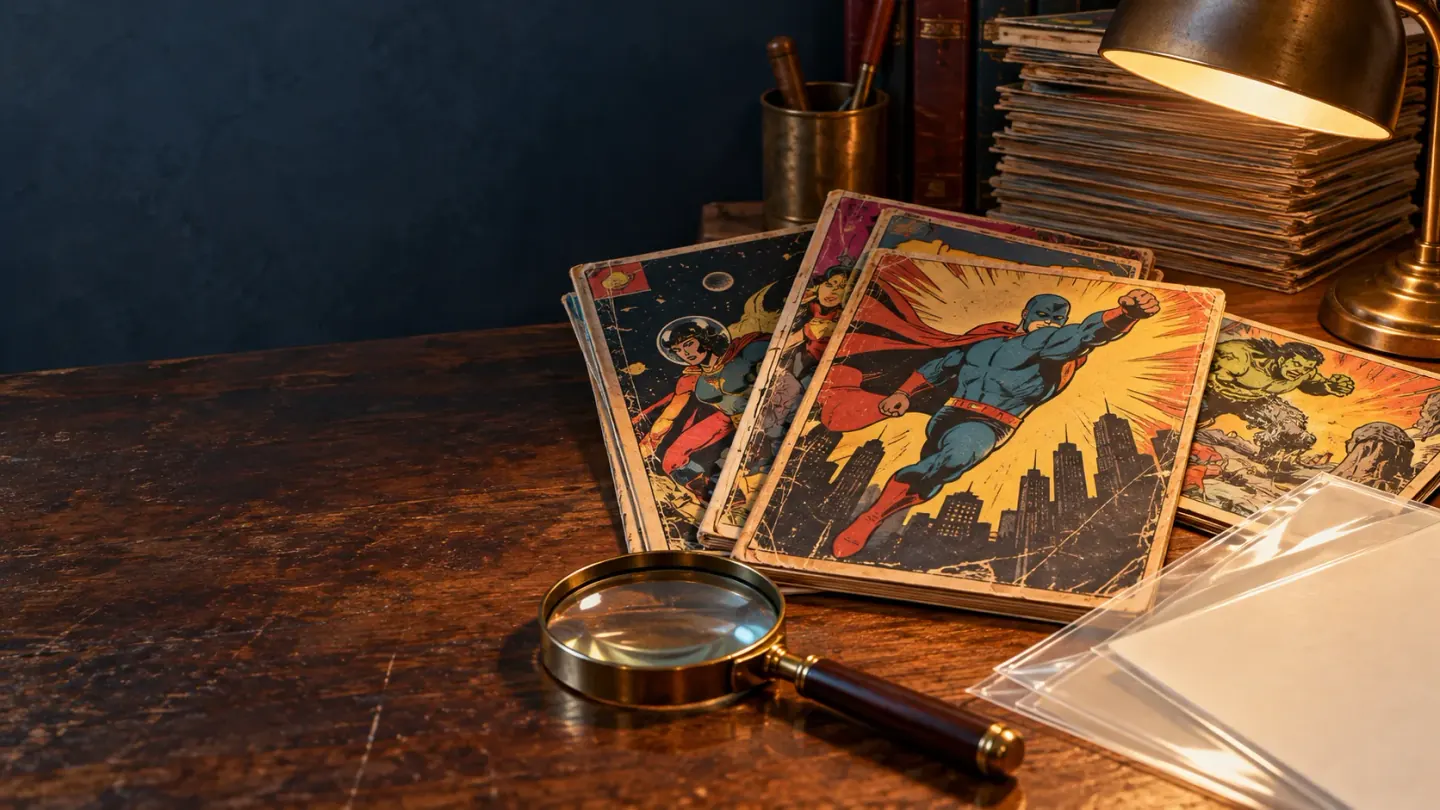
Bronze Age comics are generally grouped around 1970–1985, but the boundary is a collector convention. What matters for a valuation is the exact issue, printing, completeness, and condition—not the era label by itself. A practical first pass is to pull out documented keys, verify whether each copy is an original issue, estimate a conservative grade, and then compare like-for-like completed sales.
The image above is an AI-generated editorial illustration. It is conceptual artwork, not a photograph of a sale, a grading label, or evidence of a comic’s value.
Bronze Age key issues worth identifying
These examples are useful identification anchors, not price promises. The linked ComicValue records can help you confirm issue metadata before researching the market:
| Issue | Why collectors flag it | What to verify |
|---|---|---|
| Incredible Hulk #181 (1974) | Wolverine’s first full appearance, following his brief debut in #180. | Check page completeness, the Marvel Value Stamp, and whether the book is a later facsimile. |
| Giant-Size X-Men #1 (1975) | Relaunch of the X-Men roster and an important Wolverine team milestone. | Confirm the original 1975 issue, ad pages, staples, and restoration. |
| Tomb of Dracula #10 (1973) | Marvel’s official issue page identifies Blade’s first appearance. | Confirm the title, 1973 issue, page count, and any subscription or coupon material. |
| Batman #357 (1983) | DC identifies Jason Todd’s original introduction in this issue; his later origin differs. | Distinguish the original periodical from the later facsimile; inspect the cover, ads, and paper. |
| Amazing Spider-Man #129 (1974) | Punisher debut; research it separately from later Punisher series. | Verify indicia, page count, and that it is not a reprint or facsimile. |
The significance claims above are based on publisher references: Marvel’s Wolverine costume history, Marvel’s Tomb of Dracula #10 page, Marvel’s Punisher debut listing, and DC’s Robin history. They establish identification context, not a current market quote.
How to identify an original Bronze Age copy
Start with the indicia inside the book. Record publisher, title, issue number, cover date, and any price or distribution note. Then compare the cover and interior against a reliable issue checklist. Facsimiles and collected editions can reproduce the cover art closely while differing in paper, indicia, ads, and production date. A familiar cover is not enough.
For a raw copy, photograph the front, back, spine, staples, and every page that carries a coupon, stamp, or ad. On Hulk #181, for example, a clipped Marvel Value Stamp is a material completeness issue even when the cover looks sharp. Do not call a copy a newsstand, Canadian-price, direct, or variant edition unless the indicia and cover details support it.
Condition and restoration change the answer
Use a grade range until the book is examined under good light. Look for spine ticks, color-breaking creases, corner blunting, staple stress, tears, stains, page softness, missing pieces, and writing. Page quality is a separate observation. CGC’s grading scale explains both numeric grades and page-quality terms; its restoration guidance also distinguishes conservation from restoration. A claimed “9.8 candidate” is not a grade, and a slab is not proof that two copies are otherwise identical.
Pressing or cleaning can change appearance, but it cannot restore missing paper or make an incomplete book complete. Before paying for work, compare the likely uplift with submission, shipping, insurance, and selling costs. If restoration is possible, disclose it when asking for a comparison or listing the book.
A repeatable Bronze Age valuation workflow
- Create an identity record. Write title, issue, publisher, cover date, cover price, indicia details, edition, and completeness notes. Link the record to the closest ComicValue issue page where available.
- Separate originals from later products. Check indicia, ads, paper, barcode or price box, and page count. Keep facsimiles and reprints in a separate row.
- Bracket condition. Use a conservative low/high grade range and note page quality, restoration, and missing inserts. If a defect is uncertain, record it as unresolved until inspected.
- Find comparable completed sales. Use sold results from a reputable auction archive or marketplace. Match issue, edition, grade, page quality, restoration status, and currency. Ignore unsold listings and asking prices when estimating a market range.
- Normalize the comparison. Record sale date, hammer or total price, buyer’s premium if known, and shipping. A single headline sale is an anecdote; several comparable results are a range with sampling limits.
- Choose the next action. A low-value common copy may be best sold raw or bundled. A scarce, complete key may justify a professional opinion or grading quote. Keep a dated evidence log so the estimate can be updated rather than presented as permanent.
This process is deliberately different from a generic scanner result: it preserves edition and condition variables that an image match can miss. An app can help with a first-pass identity, but it cannot replace a completeness check or a matched-sales review.
Worked example: completeness comes before the median
Imagine an ungraded copy of a fictional 1976 issue. You confirm its printing but have not checked the interior. Your search turns up these invented teaching figures in US dollars, with shipping included and tax excluded:
| Candidate comparison | Hypothetical total | Decision |
|---|---|---|
| Same printing, raw, complete, similar visible wear | $72 | Provisional match; inspect your interior first |
| Same printing, raw, complete, similar visible wear | $84 | Provisional match under the same condition assumption |
| Same issue, certified 9.8 | $420 | Separate grade category; exclude from the raw group |
| Modern facsimile using the same cover art | $9 | Different product; exclude |
The two provisional raw comparisons span $72–$84, with a midpoint of $78. That midpoint is not an appraisal, a forecast, or a reliable estimate from two observations. If your copy has a clipped coupon or missing page, even this small comparison set stops being suitable. Find incomplete-copy sales or seek a qualified opinion; do not invent a percentage discount from complete copies.
For a real research record, add each sale’s URL, date, currency, seller’s condition description and completeness evidence. Our sold-price worksheet explains accepted-offer and shipping caveats. Compare any proposed certification expense with the raw-versus-graded budget. Once the identity is settled, use the storage guide to reduce avoidable handling damage.
Common limitations
Bronze Age supply is uneven. A census count is not the same as the number of surviving copies, and auction results overrepresent books that sellers chose to submit or promote. Prices can differ by venue, buyer’s premium, currency, and timing. Movie or streaming attention can change demand quickly, while a visually attractive copy can still have a hidden restoration or missing insert. Treat every estimate as a dated range with evidence, not a guaranteed selling price or investment forecast.
For a broader identification checklist, read how to find a comic book’s value and how to tell if a comic is valuable. When you have a clean cover photo and issue details, ComicValue is available on iOS and Android as a starting point for organizing your research.
Frequently Asked Questions
What years are the Bronze Age of comics?
There is no single official boundary. Collectors commonly use about 1970–1985, with the transition marked by changing prices, paper, stories, and publishing practices. Treat the dates as a useful market shorthand rather than a rule.
Which Bronze Age comics should I check first?
Start with documented first appearances and major status changes, such as Incredible Hulk #181, Giant-Size X-Men #1, Tomb of Dracula #10, and Batman #357. A key label alone does not determine a price: edition, completeness, grade, and current demand still matter.
Do Bronze Age comics have value if they are not high grade?
Yes. Important keys can trade in many grades, but defects, missing coupons or pages, restoration, and brittle paper can change the market dramatically. Compare the exact grade and attributes rather than applying a single multiplier.
Explore Key Comic Price Guides
Action Comics #1 (1938)
Explore the issue and valuation context
Detective Comics #27 (1939)
Explore the issue and valuation context
Amazing Spider-Man #300 (1988)
Explore the issue and valuation context
Incredible Hulk #181 (1974)
Explore the issue and valuation context
Browse our master price guide directory for 250+ key issues.