

Silver Age Comic Book Values (1956–1970): Key First Appearances & Market Performance
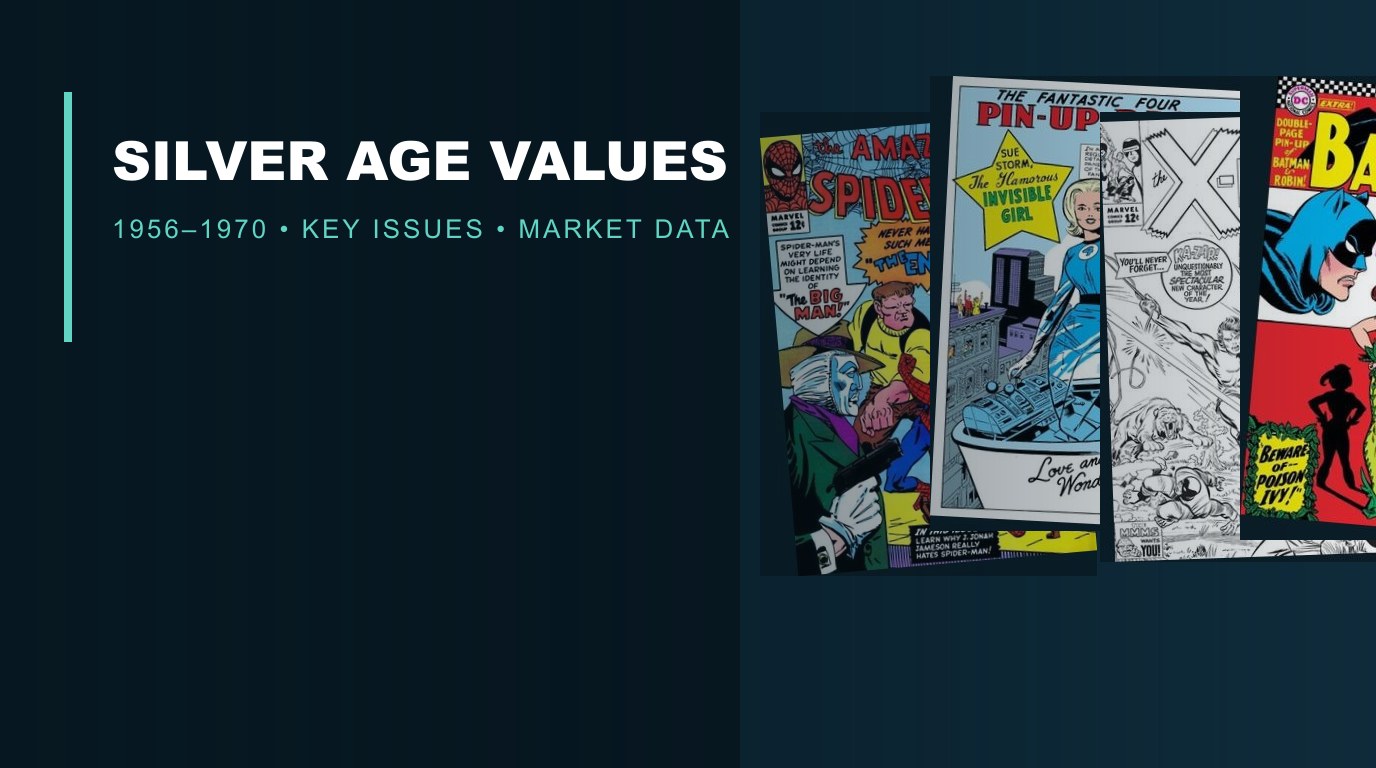
The Silver Age of Comic Books (1956–1970) represents the most financially lucrative and revolutionary era in sequential art history. Sparked by DC’s sci-fi superhero revival and powered by Marvel’s legendary creative explosion led by Stan Lee, Jack Kirby, and Steve Ditko, Silver Age key issues stand as the bedrock of modern pop culture collecting.
Whether you’ve inherited a vintage collection or are looking to invest in blue-chip pop culture assets, understanding Silver Age comic book values is essential. In this guide, we cover key first appearances, paper quality benchmarks, structural rarity factors, and market performance trends.
Defining the Silver Age Era (1956–1970)
The Silver Age emerged following the post-WWII decline of superhero titles and the implementation of the Comics Code Authority in 1954.
- The Starting Benchmark (October 1956): DC Comics released Showcase #4, introducing a modernized, sci-fi revision of The Flash (Barry Allen). Its instant commercial success proved superheroes were back.
- The Marvel Renaissance (1961–1963): Marvel Comics published Fantastic Four #1 (1961), followed in rapid succession by The Incredible Hulk #1, Amazing Fantasy #15, Thor (Journey into Mystery #83), Iron Man (Tales of Suspense #39), The Avengers #1, and X-Men #1.
- The Ending Transition (1970): The era concluded around 1970 as story themes shifted toward darker social realism in titles like Green Lantern/Green Arrow #76 and the shift to 25-cent cover prices.
Top 10 Most Valuable Silver Age Key Issues
Silver Age values vary significantly based on grade and character popularity. Below are the top blue-chip Silver Age keys ranked by historical sales performance and market demand:
| Title & Issue Number | Key Significance | Release Year | Estimated CGC 9.0 Value | Estimated CGC 4.0 (Mid-Grade) |
|---|---|---|---|---|
| Amazing Fantasy #15 | 1st Appearance of Spider-Man | 1962 | $150,000 – $400,000+ | $25,000 – $45,000 |
| Fantastic Four #1 | 1st Fantastic Four (Birth of Marvel Universe) | 1961 | $80,000 – $200,000+ | $12,000 – $22,000 |
| Showcase #4 | 1st Barry Allen Flash (Start of Silver Age) | 1956 | $60,000 – $150,000+ | $10,000 – $18,000 |
| Incredible Hulk #1 | 1st Appearance of the Incredible Hulk | 1962 | $75,000 – $180,000+ | $14,000 – $25,000 |
| X-Men #1 | 1st X-Men & Magneto | 1963 | $35,000 – $85,000+ | $6,000 – $12,000 |
| Avengers #1 | 1st Avengers Team | 1963 | $25,000 – $60,000+ | $4,500 – $9,000 |
| Tales of Suspense #39 | 1st Appearance of Iron Man | 1963 | $30,000 – $70,000+ | $5,000 – $10,000 |
| Journey into Mystery #83 | 1st Appearance of Thor | 1962 | $25,000 – $55,000+ | $4,000 – $8,000 |
| Brave and the Bold #28 | 1st Justice League of America | 1960 | $20,000 – $50,000+ | $3,500 – $7,000 |
| Amazing Spider-Man #1 | 1st Solo Spider-Man Issue | 1963 | $30,000 – $75,000+ | $5,000 – $10,000 |
Key Rarity & Condition Factors for 1950s & 1960s Comics
Unlike modern variant covers printed on thick cardstock, Silver Age comics were mass-produced on low-grade paper intended to be read once and thrown away. Finding books in high grade is mathematically rare due to several structural factors:
1. High-Acid Newsprint & Page Tanning
1960s paper stock contained high wood-pulp content. Over time, exposure to oxygen and sunlight causes pages to yellow or brown (“tanning”) and turn brittle. Books featuring White Pages or Off-White to White Pages command a 20%–50% market premium over tan-paged copies.
2. Dark Covers & Spine Chipping
Titles like Incredible Hulk #1 (gray/black cover) and Amazing Spider-Man #1 (dark yellow/blue background) highlight wear easily. The black ink on Silver Age spines frequently chips off along the staple folds, making high-grade 9.4+ copies exceptionally rare on the CGC census.
3. Marvel Corner Cut-Outs & Stamps
In the late Silver and early Bronze Age, readers frequently cut out coupon offers or Marvel Value Stamps. Always inspect interior pages of raw Silver Age books to verify completeness.
Market Performance: Silver Age vs. Other Eras
Silver Age key issues behave like blue-chip financial assets. While modern speculative variants experience extreme price volatility tied to movie rumor cycles, vintage 1960s Marvel and DC keys have demonstrated steady long-term appreciation over decades.
       Average 10-Year Value Growth Trajectory
       ---------------------------------------
       [Golden Age (1938–1955)]  ████████████  +120% (Ultra High Cost Entry)
       [Silver Age (1956–1970)]  ████████████  +140% (Optimal Liquidity & ROI)
       [Bronze Age (1970–1985)]  █████████     +95%  (Strong Growth)
       [90s Modern Era]          ████          +35%  (High Supply Volatility)
How to Value and Authenticate Your Silver Age Collection
If you come across a stack of 1960s comics, follow these valuation guidelines:
- Scan the Cover Art: Use the ComicValue app on your phone to instantly scan the cover, detect issue numbers, and pull current sales benchmarks across raw and graded conditions.
- Check for Facsimiles and Reprints: Many Silver Age holy grails were reprinted in the 1970s (such as Marvel Tales or Golden Record Reprints). Look closely at the cover price (12¢ is original Silver Age; 20¢–25¢+ indicates a later reprint).
- Compare Against Historical Guides: Review our breakdown of Golden Age Comic Values for earlier books, examine our general master guide on how to find comic book values, and see where your books rank in our list of the most valuable comic books of all time.
Summary: The Financial Power of the Silver Age
Silver Age comic books represent the golden intersection of cultural impact, historical importance, and proven long-term value growth. From Spider-Man’s debut in Amazing Fantasy #15 to the formation of the Avengers, 1960s key issues remain the most sought-after segment of the comic book marketplace.
Want to check what your Silver Age comic books are worth today? Download ComicValue for free on iOS and Android to scan your collection and get instant market prices.
Frequently Asked Questions
What dates define the Silver Age of comic books?
The Silver Age of comic books spans from 1956 to 1970, beginning with DC's Showcase #4 (1st Barry Allen Flash) and concluding around 1970 with landmark transitions like Green Lantern #76 and Amazing Spider-Man #121.
What is the most valuable Silver Age comic book?
Amazing Fantasy #15 (1st appearance of Spider-Man, published in 1962) holds the record for the most valuable Silver Age comic book, with high-grade CGC copies selling for over $3.6 million at auction.
Why are Silver Age Marvel comics worth so much money?
The Silver Age birthed the modern Marvel Universe created by Stan Lee, Jack Kirby, and Steve Ditko. First appearances of flagship icons like Spider-Man, the Avengers, Iron Man, the X-Men, and Thor possess massive pop-culture liquidity.
How does paper condition affect Silver Age comic values?
Silver Age comics were printed on cheap newsprint prone to oxidation, tanning, and spine chipping. High-grade unslabbed copies grading CGC 9.0 or above are structurally rare, commanding massive price premiums.
Explore Key Comic Price Guides
Action Comics #1 (1938)
Explore the issue and valuation context
Detective Comics #27 (1939)
Explore the issue and valuation context
Amazing Spider-Man #300 (1988)
Explore the issue and valuation context
Incredible Hulk #181 (1974)
Explore the issue and valuation context
Browse our master price guide directory for 250+ key issues.