

Batman Comic Book Value Guide: Key Issues & Price Trends
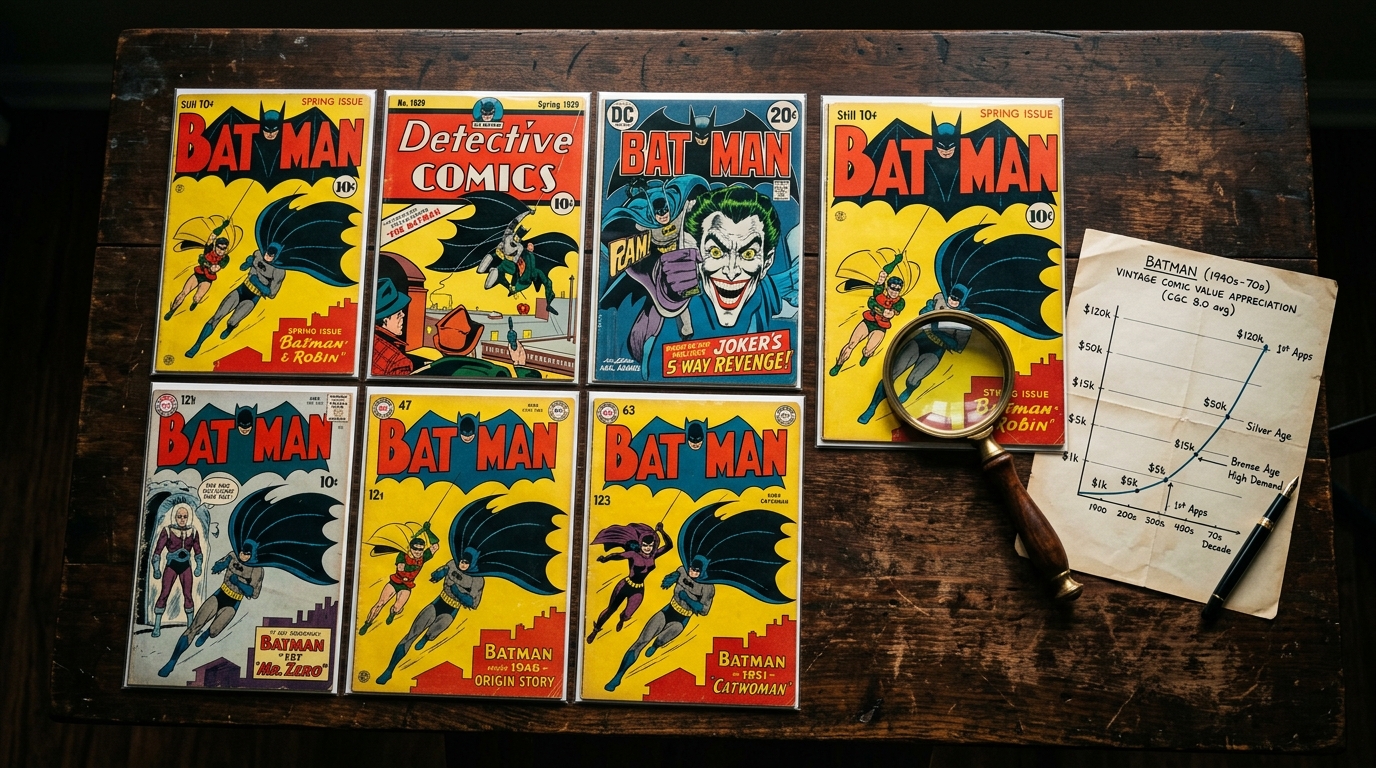
Batman is arguably the most recognizable superhero in pop culture, and his comic books remain cornerstones of the collectible market. From multi-million dollar Golden Age debuts to undervalued 1980s key issues, understanding Batman comics value requires knowing which issues hold real historical demand.
Whether you inherited a collection or found a stack of Dark Knight comics at a garage sale, this price guide covers key Batman issues across every era and explains what drives their market price.
1. Golden Age Batman Keys (1939–1955)
The Golden Age represents the pinnacle of Batman collectible value. These issues are structurally rare because WWII paper drives and vintage reading habits destroyed most copies.
Detective Comics #27 (1939) – 1st Appearance of Batman
- Historical Significance: The issue that introduced the Bat-Man created by Bob Kane and Bill Finger.
- Value Range: $500,000 (Fair/Good) to $1,500,000+ (NM 9.0+).
- Market Note: Only around 100 copies are known to exist in CGC census records.
Batman #1 (1940) – 1st Joker & Catwoman
- Historical Significance: Batman’s first solo title, featuring the debuts of both The Joker and Catwoman (The Cat).
- Value Range: $40,000 (Low grade) to $2,000,000+ (CGC 9.4+).
Detective Comics #38 (1940) – 1st Appearance of Robin
- Historical Significance: The debut of Dick Grayson introduced the superhero sidekick archetype to comic history.
- Value Range: $15,000 to $250,000+ depending on grade.
For more details on early vintage paper value, see our breakdown of Golden Age comic book values.
2. Silver Age Batman Keys (1956–1970)
The Silver Age brought iconic rogues and campy sci-fi storylines. High-grade Silver Age Batman issues carry strong collector demand.
| Key Issue | Significance | Est. Raw Value (Mid-Grade) | Est. CGC 9.8 Value |
|---|---|---|---|
| Batman #121 (1959) | 1st Appearance of Mr. Freeze (Mr. Zero) | $350 – $800 | $15,000+ |
| Detective Comics #359 (1967) | 1st Appearance of Batgirl (Barbara Gordon) | $400 – $1,200 | $18,000+ |
| Batman #181 (1966) | 1st Appearance of Poison Ivy (with centerfold insert) | $300 – $700 | $12,000+ |
| Batman #227 (1970) | Iconic Neal Adams Gothic Cover (Homage to Det #31) | $200 – $450 | $4,500+ |
Note: Batman #181 must retain its intact centerfold pin-up poster to command full market value.
3. Bronze Age & Copper Age Batman Keys (1970–1991)
The Bronze Age introduced darker, ground-level storytelling by creators Denny O’Neil, Neal Adams, and Jim Aparo. These keys offer an accessible entry point for investors.
Batman #232 (1971) – 1st Appearance of Ra’s al Ghul
- Why It’s Valuable: Classic Neal Adams cover artwork and the introduction of one of Batman’s greatest arch-nemeses.
- Value: Raw mid-grade copies run $150–$300, while a CGC 9.8 can fetch $3,500–$5,000.
Batman #357 (1983) – 1st Jason Todd & Killer Croc
- Why It’s Valuable: Debuts Jason Todd (who later becomes Red Hood) and Killer Croc.
- Value: Raw NM copies sell for $80–$150, while CGC 9.8 copies range between $500 and $800.
Batman #404–407 (1987) – “Year One” by Frank Miller
- Why It’s Valuable: Defines Batman’s modern origin story.
- Value: Complete 4-issue set sells for $40–$100 raw; high-grade newsstand copies command 2x premiums.
Batman #428 (1988) – “A Death in the Family” (Death of Jason Todd)
- Why It’s Valuable: Fan call-in vote issue resulting in Jason Todd’s death.
- Value: $30–$75 raw; $200–$350 in CGC 9.8.
4. Modern Age & 90s Batman Keys (1992–Present)
While many 1990s comics suffered from overproduction, specific key debuts and low-print variants retain substantial market value.
- Batman Adventures #12 (1993): 1st appearance of Harley Quinn in comics. Raw copies sell for $400–$700, while CGC 9.8 copies fetch $1,800–$2,500+.
- Batman #608 (2002): Beginning of Jim Lee’s “Hush” storyline. The RPP variant and convention foil covers sell for hundreds.
- Batman #655 (2006): 1st appearance of Damian Wayne. Raw NM copies run $40–$80; CGC 9.8 copies reach $250–$400.
- Batman #1 (2011 Scott Snyder New 52): 1st appearance of the Court of Owls. A cornerstone modern key issue.
Learn more about evaluating 1990s comic prices in our guide: Are 90s Comic Books Worth Anything?.
What Drives Batman Comic Values?
When determining the value of Batman comics, keep these three crucial factors in mind:
- Condition & Page Quality: Spine stress marks, soft corners, or yellowed pages drastically lower value. A single grade jump from CGC 9.6 to 9.8 can double a comic’s resale price.
- Newsstand vs. Direct Edition: For Batman comics published between 1986 and 1999, look at the bottom left corner. If there is a barcode instead of a logo/character graphic, you have a Newsstand edition, which often carries a 2x to 5x premium due to lower surviving supply.
- Key First Appearances: Origin issues and first character debuts consistently outperform standard storyline issues over time.
Compare Batman keys with the most valuable comic books of all time to see how Dark Knight titles compare across the wider market.
How to Value Your Batman Collection Instantly
Don’t manually search hundreds of Batman issues one-by-one. Use the ComicValue app to scan your covers with your phone camera, detect newsstand variants automatically, and check real-time sales data.
Want to find out what your Batman comics are worth? Download ComicValue for free on iOS and Android and value your collection today.
Frequently Asked Questions
How much are old Batman comics worth?
Values range from $10 for common 1980s issues to over $1,000,000 for holy grails like Detective Comics #27 (1st Batman) and Batman #1 (1940).
Which 1980s and 1990s Batman comics are valuable?
Key issues include Batman #357 (1st Jason Todd & Killer Croc, $100–$600+), Batman #428 (Death in the Family, $40–$250+), and Batman Adventures #12 (1st Harley Quinn, $400–$2,000+).
How do I check the value of my Batman comic books?
Scan your cover with the ComicValue app or search verified eBay sold listings. Check for issue number, newsstand barcode variants, and spine condition.
Why are some Batman newsstand comics worth more than direct editions?
Late 1980s and 1990s newsstand Batman comics were printed in much lower quantities than direct comic shop copies, making high-grade newsstand copies significantly rarer.
Explore Key Comic Price Guides
Action Comics #1 (1938)
Explore the issue and valuation context
Detective Comics #27 (1939)
Explore the issue and valuation context
Amazing Spider-Man #300 (1988)
Explore the issue and valuation context
Incredible Hulk #181 (1974)
Explore the issue and valuation context
Browse our master price guide directory for 250+ key issues.